Thursday, March 16, 2017

Pets know when you hurt

Have you ever seen a family pet curl up with someone who isn't feeling well, apparently knowing the person is hurting? I never believed it myself, at least until we got a cat. This cat knows! I swear. Before I had my knees replaced, she would curl up beside me while I struggled with the pain. It happened often enough that I couldn't ignore the connection. Now, the cat is sitting at my shoulder, purring contentedly, just to give me company. It's uncanny.

image credit
My question doesn't really need an answer, but it's this, "Why do pets form such deep relationships with us?" I'm sure there's many reasons, and probably quite a few books written about the subject. To me, pets connect with us in a way no human can. There's a bond which goes beyond life itself. It's so special that I would wish all children could have pets, but I know sometimes it's just not practical or possible. A pet gives children something smaller than themselves to take care of, and the bonds between them develop almost instantly--it's a privilege to witness the process.

Being on the receiving end of that love and attention is comforting and disturbing. How can such grand emotion cross between such completely different beings? Yet, it does. Our pets become as much a part of our hearts as any other segment of our own bodies. So, yes, pets do know we hurt. How could they not? They're a part of us.

- M

Tuesday, March 14, 2017

Memories of home

There are sounds that instantly bring to mind your home, or smells which trigger memories of your mother's cooking, and photos you will never get rid of because they are simply too precious. There's a saying, "Home is where the heart is," but I think we place far more importance on home than leaving it as a trite concept. We remember our childhood homes with fondness exceeding any actuality and push them firmly into happy fantasy. In some ways we spend the rest of our lives searching for a way to return to those long-gone days.

Having been born in another country, and living my first seven and a half years there, I remember pretty well a few things (not as much as I'd like though). I keep a flower from there, and if I allow myself to dwell on memory it won't take long before tears are flowing. Incredible how powerful the memory of childhood is! I wish I had kept some trinkets from then, but children aren't the best at keeping memories.

Throughout our lives, we might have many homes, and all of them affect us deeply. On some level, we sink down roots and are reluctant to leave. Sure, there are places we are happy to leave, yet we still remember them. It's a funny quality. Nostalgia could explain it, I guess. I'm not sure though. We leave a piece of ourselves in the places we live. When we leave, a part of us feels distant and lost.

Here's hoping your memories of home are sweet and well remembered.

- M

Sunday, March 12, 2017

Super intelligent characters -- like Sherlock Holmes

The long history of Sherlock Holmes testifies to how much audiences love smart characters. Of course, we naturally assume that the authors are equally intelligent. While that certainly can be the case, it doesn't have to be. Authors shouldn't limit themselves because they aren't super geniuses. What matters is keeping the story ahead of where the audience is at. There are lots of techniques to do this, such as preventing audiences from learning critical facts, completely leaving out information, and basically giving the audience no hope whatsoever of guessing the truth. These are bad ideas.

Many times it helps to put together a "map" of the story ahead of time. This can take form as an outline, bullet points, or even simple 3x5 cards. The importance is so the author knows ahead of time what's going on and all the relevant information. This way, it's only natural for the "smart" character to be ahead of the audience. Many of the little inferences made by Sherlock Holmes seem rather crazy on retrospection. In the "Sherlock" BBC television show, the first time Sherlock meets Watson, there's a series of deductions made about Watson's phone--deductions that fall apart with a little bit of thought. Despite these things, the scene works perfectly and Sherlock comes off as a brusque, but very astute observer who's intelligence can be trusted. That's a great way to show super intelligent characters.
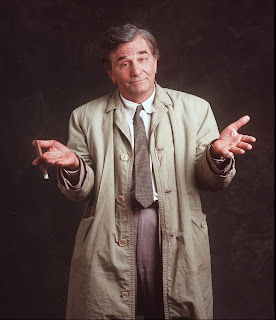
Peter Falk as detective Columbo
Another method I particularly enjoy is watching characters behave in a bumbling sort of way, but who are actually far more intelligent and observant than they appear. "Columbo" is the prime example of this, as this detective purposely behaves like an oaf so the suspects are put into a false sense of ease. The joy of this method, is the audience has all the same evidence the detective has (even further, as the audience watches the murders happen onscreen, with all preparations intact). Yet, the audience still lags behind the super intelligent hero because we haven't made all the connections necessary to reveal the truth.

Don't let creating super intelligence get in the way of simple storytelling. So long as the author knows what's going on, and gives little hints again and again, the audience will happily go right along with believing in the intelligence of the hero and won't even try finding faults in the logic of events ... at least, not until the story is over and they are trying to figure out how they missed it all.

- M

Thursday, March 9, 2017

We idolize heroes, but particularly athletes

When you watch events such as championship games, or yearly competitions, and especially the Olympics, it's easy to idolize the athletes. It's probably the most obvious display of performing beyond natural limitations. These athletes inspire us with their great fortitude, heart, and unwillingness to accept anything less than their best. Images of people willing pressing forward, despite injury (mind or body), will make our hearts swell with pride simply for being a fellow human being.
Pole vaulting, a true hero sport
image credit
 Any competition has victors and losers. Fans go berserk when their team wins, but also when they lose. Athletes face this constantly, and anyone watching gets to see how they react. Seeing a heroic athlete accept defeat with grace, and win with equal grace, is inspiring. We all hopefully want to be better than we typically are. So, athletes easily become role models (despite the actual quality of the particular athlete). Those wise enough to understand this will do their utmost to display their best and shove down their worst.

Finally, for those of us who cannot possibly perform athletics on par with Olympians, we live vicariously through the athletes we watch. It's a concept called "projection." It's when you place your own self onto another (sometimes in a good way, others in a bad). With athletes, we want to be the ones performing the stunning backflips and incredible feats of human perfection. There's nothing wrong with it, as it's a key part imagination, and even helps us yearn to do better. Which is why sporting events are so amazingly popular -- I just can't imagine anyone watching two physicists battling out with math theorems of dimensional geometry ... but I can hope!

- M

Monday, March 6, 2017

Blind, with both eyes open. You aren't clumsy ... it's a prankster!

Have you ever walked into a doorframe, despite the fact that you were watching where you were walking? Or, has a wall reached out and smacked you in the face, even though you were in the middle of the hallway? What about tripping over a non-existent rock? It's a mystery, but I'm here to explain it...

My best friends will tell you that I've had plenty of experience with these phenomena, and I'm here to tell you there's a simple explanation. Gremlins.

Back in World War 2, pilots blamed unexpected malfunctions to otherwise perfectly fine aircraft on malicious invisible pranksters they named "Gremlins." Unexplained malfunctions plagued pilots, and made airplane mechanics scratch their heads. Once the planes were back to base, many times there was no cause found whatsoever. Problems just ... appeared.

As I explained about socks vanishing inside dryers, this also is due to a previously unknown creature. Gremlins are invisible, incredibly fast, and prone to fiddle with anything electronic or mechanical. So, what does this have to do with bumping into walls and tripping over your own feet? Well, it's because gremlins also have a powerful local gravity field. You weren't being clumsy, you just fell into their gravity well. Nerdy way of saying you got pulled in. The best response in these situations is to aim a swift kick at the invisible creature and shout loudly.

Trust me, it works.

- M

Saturday, March 4, 2017

Make more Tolkien movies, pretty please.

The successes of the "Lord of the Rings" movie trilogy, followed by "The Hobbit" trilogy demonstrates the world has a great appetite for epic fantasy. There are mole Tolkien works available, and even further ones by Christopher Tolkien in the same expansive world. The biggest would come from "The Silmarillion." J.R.R. Tolkien spent a huge amount of effort creating not only the world, but all the stories covering its past. While "The Silmarillion" attempts to tell a cohesive story, it's really more of a series of short tales which a movie could easily latch onto and make real.

I don't see any reason we cannot have single movies within Tolkien's universe. They don't all have to be epically long trilogies. Why not tell the story of the creation of Middle Earth, which is a wonderful scene of creation where it is actually sung into existence. The story of how evil came about and festered is all part of it. Or, the corruption of the elves (hinted at in the "Lord of the Rings" trilogy, but never explained). There are many, many, many, many captivating stories contained in chunks. Just give us a story within a single movie, and let it be at that.

April Fools joke from the "Skiffy and Fanty Show"
Maybe a resurgence of fantasy movies will happen, as it has with superhero movies. I love a good fantasy story to share with my wife--snuggle time. More than that, I feel fantasy encourages imagination more than any other genre. Anything is possible with fantasy, and it's so easy to capture the attention of any age with mysterious dragons and heroes and villains.

Please, Hollywood, make some more Middle Earth movies! I'll definitely go see them.

- M

Thursday, March 2, 2017

Immortality--living beyond your natural life.

Many people have wished for immortality, but there are more definitions beyond the typically thought of never ending life. Your name and lineage can extend into time. Your physical creations may survive for ages--buildings, paintings, sculptures, and so on. Ideas far outlast the people who dream them up. There's an interesting dialogue in the movie, "Troy," where Achilles is speaking about being remembered for great deeds and how that is true immortality. He makes a good point.
Plitvice Lakes National Park
 Why do we have such a deep desire to live forever? Maybe it's because we realize life is short and uncertain. We want to stave off death. We're afraid to face our own ending? I think it's not so simple, though. I think we hope we are remembered beyond our meager lives. We want a legacy that outlasts us. Like Achilles, we want people to talk about us far into the future. We want to make an impact on the world we inhabit.

There are legends and myths about objects which can grant eternal life, heal incurable wounds, and bring to life the dying. People have spent their entire lives searching for these things. Despite the lack of success, more will continue to look. I wonder what would happen if such an item were actually found? How would the world change? Who would have access to it? Would the world know, or keep it a secret? Could everyone have a drink from the Fountain of Youth?

- M