Showing posts with label villain. Show all posts

Tuesday, April 10, 2018

Heroes and Villains in a modern world

Historically, heroes and villains have been stark contrasts. The good guy wears a white hat, and the bad guy wears a black one. In the past dozen years, there's been a wave of darkness over these themes, which has blurred the concepts quite a lot. The version of Batman from Christopher Nolan's movies follows Frank Miller's "Dark Knight" vision--a much grittier and world-weary Batman. But, that trend is reversing. Today's Marvel movies have crystal clear heroes, and the villains are pretty obvious. Considering how fantastically well these films are doing, financially, I'm betting audiences want that clarity again.
The great hero Odysseus confronting the sorceress Circe.
I suppose it's no surprise that people don't want their stories to be dreary and depressing all the time. Sure, it's more realistic, but wow, what a downer. Examine stories that have stood the test of time, and you'll find heroes and villains very plainly drawn. In fact, heroes tend to be paragons of virtue, and villains are scenery-chewing monsters. Good triumphs, and evil goes down in flames, yet it's a harsh struggle to survive. Despite the foregone conclusion of the outcome, the excitement is in the heroic journey and growth of determination in the hero.

So, I believe we are yearning once again for unrealistically pure heroes. Such heroes challenge us to be better than we are; braver, stronger, more willing to risk and lose. Heroes are the ultimate role models, imbued with everything we cherish and hope for in ourselves. Sure, that's unrealistic and ridiculous, but it's fiction so why not revel in audacity? We could use a few pillars of virtue in our modern stories. As much as I admire the darker Batman's realism, I wouldn't want him as a neighbor, but I'd love Odysseus (despite his scheming ways) because I know he would always protect me.

- M

Monday, February 12, 2018

Fighting the big bad in superhero stories

I think it's fair to say that most superheroes fight a big battle at the end of nearly every story. This isn't a bad thing, and definitely fits well into the Three Act structure. I do have a question about the final battle. What form does the fight take, and should it only be against the villain personally? For instance, in the classic "Sleeping Beauty" (which has my favorite villain of all time, Maleficent), it is completely possible for the hero to fight his way to the heroine and close it out without even slaying the villain. However, what this ending doesn't do is provide closure and leaves the villain to skulk about and do more evil, which is why the movie chose otherwise..

In the new DC movie, "Wonder Woman," the final villain (Ares) is only a metaphor for the entire movie, then suddenly manifests to be slain in the big fight. I think the ending would have been much better if Wonder Woman had beaten the general and his scientist, yet failed to stop war (the figurative Ares). This highlights that war/Ares is a much greater battle and a single victory won't finish it. Character growth like that can put a tidy capstone on a story, and leaves a whole lifetime of stories as possibilities. To win everything in one story pretty much completed the Wonder Woman arc and there's nothing left, at least not until there's a new super-villain to battle. This is why Batman has never completely defeated The Joker and never will.

Maybe as audiences we've become too accustomed to the idea of problems being resolved within single stories. This has been true in television for ages, though we do have season-long stories sometimes. But, as nice as it is to see the conclusion, is it what we really desire? Sure, a mystery needs a solution, and a battle needs an ending. However, I want a hero who doesn't just pop in, fix an issue, and leave. I want someone who sticks around and works hard and leads by example. Sometimes, that means losing the battle to win the war.

- M

Tuesday, December 12, 2017

Batman versus the Joker ... why are they still at it?

Batman fighting the Joker has become part of American culture, even more so than Superman battling Lex Luthor. My question is, why? The Joker is a horrible person, utterly vile, completely wicked, and excruciating to be around for any length of time. Yet, the public can't get enough of Batman fighting this singular villain. So, let's examine it for a moment.
Batman versus Joker
image credit
Batman wants to redeem people, while Joker wants to corrupt people. Batman won't compromise for any reason, while Joker is seductively flexible. Batman has rules, the Joker doesn't. Batman is the yearning to overcome any obstacle, Joker is the lunacy lurking within humanity. Joker is almost literally Batman's internal darkness come to physical life, revealing what Batman would become if he lost control completely. Batman against the Joker is a modern day retelling of the story of Jekyll and Hyde.

Certainly this struggle hasn't always been depicted the same way, but it's interesting that no matter who is writing the stories, the tension between Batman and Joker remains the same. There's an inherent understanding of what drives them both. Very simply, it's hope versus despair. Sure, Batman isn't a saint, but he's a morally driven hero, struggling to do good despite the wickedness around him. That's probably why people are drawn to Batman, because his struggles are similar to our own (though amped up to superhero proportions). The Joker is chaos and vileness personified, with the single goal of corrupting any good thing he finds.

This is why I love comics so much. Like no other medium, comic books have delved into the very nature of who we are and what makes us good or bad. It's an important study. Plus, comics have given us stories that have survived the test of time.

- M

Saturday, August 12, 2017

Now, I will explain in detail my evil plan ...

Tom Hiddleston makes a wonderfully villainous Loki, don't you think?
I've been re-reading the "Infinity Gauntlet" comics in preparation for the next Marvel Avengers movie. Something that occurs to me is how fun it is to listen to the villain explaining their plans in excruciating detail. For one, as the reader, it lets me anticipate what the heroes are fighting against, and, for another, gives me even footing regarding the plot. Sure, it's silly for the villain to "monologue," yet there's a reason so many villains do it. Without such information, the audience is constantly playing catch-up and that is only fun in certain circumstances (such as mysteries). In comics, the audience must know the stakes or they will lose interest (and stop buying the comic books, which only provide small pieces of story in every issue).

As an author, villain monologues are a complete blast to create. There's nothing quite like having the big bad guy pontificate while believing the hero is completely at their mercy. Sure, it always ends up going wrong, but there's still a lot of fun in the process. This trope is so common, that the Avenger's movie, "Age of Ultron" actually has the villain making fun of the concept of explaining his evil plan. I laughed.

Oddly, when the hero explains their plan, nobody minds. Of course, the hero is usually working from a point of adversity, whereas the villain is causing the calamity. Yes, it's all grandstanding for the audience--basically breaking the 4th wall to show off--though I've seen it used with terrifying effect. In those occasions, knowing the plan actually sets the audience on the edge of a knife, not sure what will happen.

So, it's not always a crime to let the villain explain their plan ... it just typically goes awfully awry.

- M

Saturday, June 10, 2017

The makings of a legendary villain.

Who is the arch-nemesis of Sherlock Holmes? If you've even had the slightest interest in detective fiction, then I'm sure you know the answer is Professor James Moriarty. Moriarty is the brains behind the villainy in all of London ... or is he? Would it surprise you to discover that Professor Moriarty only appears in two Sherlock Holmes stories? In written order, he appears for the very first time in the final story where he and Sherlock tumble down the Reichenbach Falls to their apparent demise. Moriarty appears once more in a story which is set prior to the other, but is only being interviewed by the police. Incredible, isn't it? Sherlock does mention Moriarty in five other stories. Arguably the most famous arch-nemesis of any fictional story is barely present!
Professor Moriarty, illustration by Sidney Paget, which accompanied the original publication of "The Final Problem"
I believe the reason is because once the audience learns about Moriarty, we seek and find his presence in a lot of Sherlock Holmes adventures. His characterization is laser sharp, absolutely believable, and it's obvious he's a match for the great detective. As an audience, we want to be as smart as Sherlock, so we look for patterns and try to jump ahead of the narrative. The very fact that we do this demonstrates how powerful the character of Moriarty is to us. It's like what Alfred Hitchcock said, "There is no terror in the bang, only the anticipation of it.” Moriarty is the anticipation of trouble.

Sir Arthur Conan Doyle absolutely knew what he was doing when he set Moriarty inside only a handful of stories. He knew the audience would immediately look for connections, and by doing so increase the power of the villain. It's an incredible trick to pull off. Whenever an author can get the audience to the heavy lifting, then the story will be all the better for it. It's well worth a study, and even more the stories are fantastic adventures!

- M

Sunday, March 26, 2017

Memorable villains.

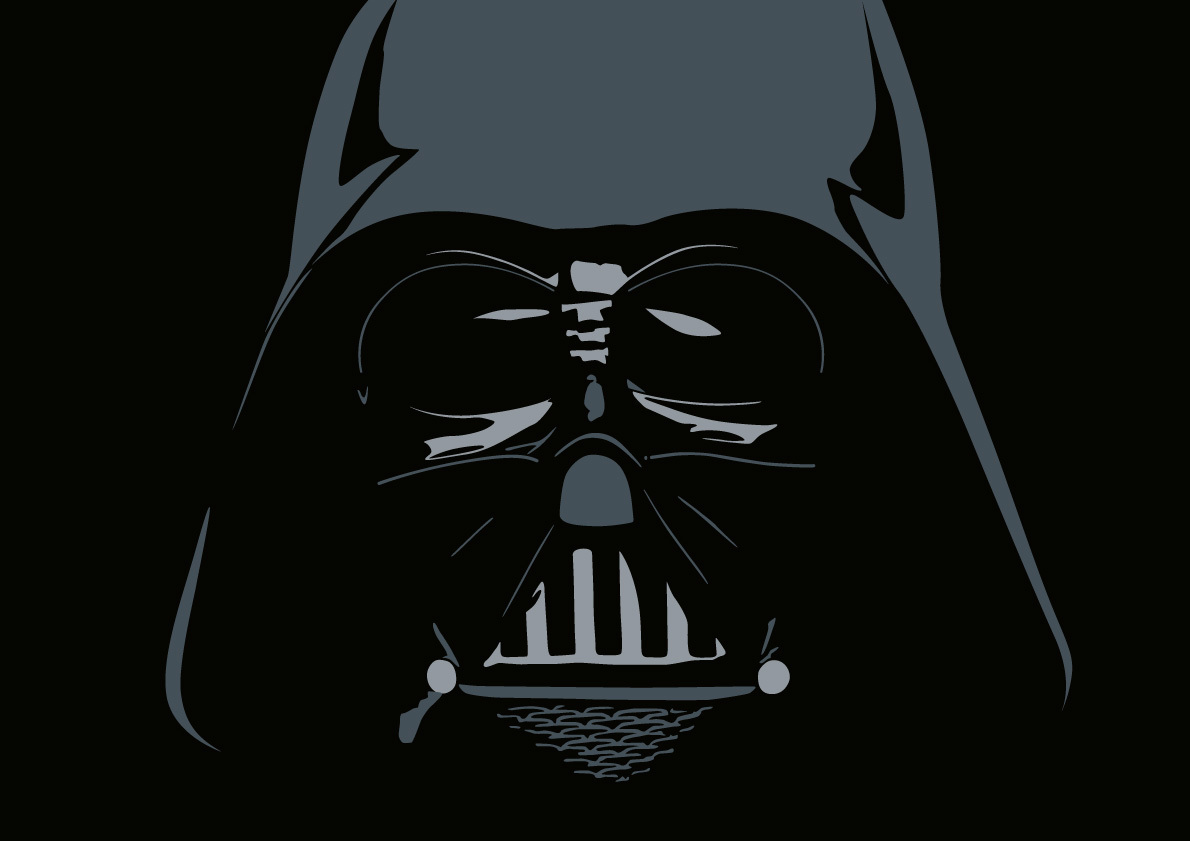
What makes a villain pop into memory? Was it because they were on the scene a lot, or because of something particular? One of my favorites, Darth Vader of Star Wars, is barely on screen—yet is physically intimidating and instantly recognizable. A villain should make the audience quiver in terror, worry for the heroes (or any innocent bystanders), and mostly drive the plot forward in vicious lurches.
Darth Vader, the original Sith Lord

I've read that actors enjoy being villains, as there's no limit to what they can do. I suppose that's true, considering heroes have rules and villains generally don't. Also, you can get away with knowing absolutely nothing about them (such as Darth Vader) and yet remain terrifying. Villains become memorable because they are astonishing to look at, do unexpected things, are super powerful, beat up little animals, or  basically make your skin crawl. There's lots of reasons. Answer this one, why is HAL-9000 (the antagonist in 2001, A Space Odyssey) still considered one of the greatest villains? You only see a camera lens and hear a voice, yet we all remember it.
 
Villains don't even need to be nasty, horrid, terrifying scarecrows. Think of Mr. Potter from It's a Wonderful Life. I loathe that character. I get physically upset when I see him. Yet, his acclaim is basically that he stymies the hero and gets in the way all the time. Amazing. I love to hate that villain.
 
One thing all great villains have, is presence. Without them, the story would be flat and uninteresting. Their very being inspires heroes to rise up and overcome them. It's a tough trick to pull off, but wow is it satisfying to witness!
 
- M

Saturday, September 10, 2016

Can you have a good story without villains?

I was reading a column about the upcoming movie "Sully," which depicts the amazing water landing of an airliner--the "Miracle on the Hudson." The article closed with the thought, "All good stories need a villain." I couldn't disagree more. Every story does require conflict, but not necessarily a villain. Think of the recent movies, "The Martian" and "Gravity." There's plenty of conflict, in the sense of surviving extraordinarily hazardous conditions, yet there are no mustache-twirling villains. The interest in these survival stories isn't how the hero is picked on, but how they lived or didn't--since these stories don't guarantee a happy ending.
 
Audiences want interesting, entertaining, captivating stories. There are many tried and tested manners of delivering such stories; frameworks and patterns diagramed and understood for centuries. In reality, there just aren't all that many sorts of stories. Depending on who you ask, you could have as few as two. Yet, all stories contain conflict, because if there's nothing happening the story is a boring research paper with no excitement. Figure out where the conflict is, and then you'll know if you need a villain.
 
If you do need a villain, then keep in mind that "heroes are only as good as their villains." If the hero is too powerful, then the villain poses no challenge and thus no conflict. Oddly, the opposite isn't true, as frequently the villain is far greater than the hero, so in these cases the hero must grow to overcome the conflict. Villains don't even need to be seen constantly to be a true threat, yet their influence must be firmly intertwined with the story to keep the conflict ever present.
 
Yes, a good story doesn't require a villain, it only must have conflict.
 
- M

Thursday, July 21, 2016

Heroes create Villains? How could that be?

The new Avenger's movie ("Captain America: Civil War") had an interesting scene, where the Vision points out that the sheer strength of superheroes incites supervillains to appear. It's a curious idea, yet I think there's a lot of truth to it. Think about our own, real, world with country superpowers and the forces aligned against them. I think the Vision has a good theory. So, would eliminating superheroes get rid of all the villains? Well ... no.
The Mad Titan, Thanos wielding the Infinity Gauntlet
You see, evil will fight anyway. They do fight harder if they are opposed, but there's no stopping it. And, that brings up another point: good tends to want to banish evil, while evil wants to destroy good. One is an ongoing victory, and the other is absolute. But, crank up the power levels of the combatants, and you then have an arms race. It's obvious really. Yes, having powerful heroes does create powerful villains.
 
And, that's great for stories, since conflict is what drives them. There becomes a kind of power creep where the heroes grow stronger, so the villains compensate to threaten them again, and so on. Eventually, a point is reached where things get ridiculously powerful and the mind boggles. This is when creators pull out their world slayers and knock everyone down a few thousands notches. I expect the Marvel universe will use the upcoming "Infinity War" movies to do exactly that.
 
In the end, though, the fun of heroes and villains is what it's all about. There's a neat kind of fantasy in watching larger-than-life shenanigans going on. "Long live the fighters!"
 
- M

Saturday, April 4, 2015

Weeping Angels ... let them weep!

I'm probably more guilty than most when it comes to overthinking plots and story ideas. I've gradually learned over the years to be more open and flexible, but it's tough. I'm sure my own stories are filled with contradictions and things people will roll their eyes at. What I've learned now is to take matters in stride and enjoy the overall movie.

Speaking of overthinking, what about one of the best episodes of the recent Doctor Who? I'm talking about "Don't Blink," which introduced the best modern scary monster of Doctor Who ... the Weeping Angels. These are creatures that turn to stone when we look at them, but otherwise move like lightning. Creepy and amazing, these things are a wonderful bad guy. Until you start thinking about it that is. After all, if they're so fast, what could possibly stop them? It's ridiculous to expect that eyes are on these creatures so much they don't kill everything around them. But, why ruin a great monster with logic? I doubt any fictional story can withstand intense scrutiny. Enjoy the scary monsters!


This is why I enjoyed Pacific Rim so much. Put your brain in the blender and let things wash over you! Stories are much more enjoyable when you let it happen without interrupting the flow. I think this one willful act is the best thing an audience can do. It used to be called "suspense of disbelief," which is hardly used anymore. When you let it happen you stop resisting the story and become a part of it. Then the real magic happens as the story surrounds you and burrows deep within. So, stop thinking so hard and wallow in the goodness of a story!

- M

Wednesday, February 11, 2015

Iconic villains

I was thinking about movie villains, and how some iconic villains have almost impossibly short screen time yet overshadow the entire movie. A couple of examples are: Darth Vader (Star Wars), and Hannibal Lecter (Silence of the Lambs). Even if you haven't seem the movies, I'll wager you all know these two characters. The incredible part is how little they are seen. Darth Vader--18 minutes of 121 minutes total; Hannibal Lecter--16 minutes of 118 total. Yet, these two villains are part of every moment in these movies due to their amazingly powerful characterization... so much so that in the next films they each played a far greater role.

What makes villains instantly memorable? Why do some capture the public's attention with seemingly no effort? How can we do the same as we create our own villains?
 
Probably the single most important answer is the author knew precisely who and what these villains were before writing a single sentence. They feel real from the moment they appear because the author already believes in them. The actors play a key aspect as well, since they provide the visuals, but since Darth Vader is a man in a suit it's mainly his characterization that gives this feel. Also the villains have clear motivations which the audience understands immediately (Darth Vader wants the plans for the Death Star back, and Hannibal Lecter wants to sadistically toy with the FBI agent).
 
The other thing is there is very little backstory to these villains. Sure, there "seems" to be, but as an audience we are given precious few bits of it. In studying villains, I've noticed that many don't really have much information as to why or how they came about. They are mostly "now" characters who are part of the story but not explained. I'm fine with that. After all, my favorite villain of all time is Maleficent (from the old animated Sleeping Beauty) who shows up and does mean and ugly things, then does it again and again. They're evil and love it.
 
My advice to authors is to make a villain you totally believe in and then write the story. The audience will follow along like puppy dogs.
 
- M

Monday, December 15, 2014

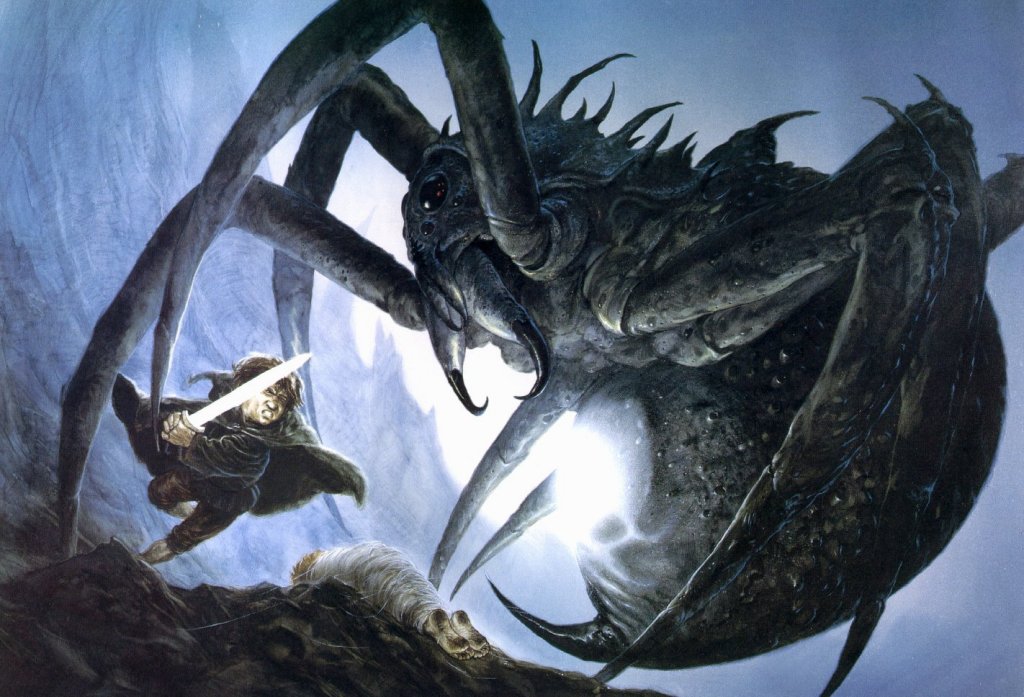
Shelob, Queen of Spiders

Frodo and Shelob
Spiders have held a strange hold on me. On one hand they are nasty things that make my skin crawl (sorry to those who like them), but on the other hand they are nifty things in stories. My favorite spider is naturally Shelob from "The Lord of the Rings." She has one of the defining scenes in the entire Middle Earth series, and is one of the few things even non-readers know about. I'm not sure why that particular scene is so memorable, but I suspect it's because the spider is huge, intelligent, and pure evil that gets curb stomped in the end.
 
Tolkien came up with expansive mythology and history explaining Shelob and the spiders of Mirkwood. It's fascinating reading, but I'll admit I have a hard time spending such long thought on history that isn't real. However, I'm deeply impressed by it and tip my hat to anyone willing to learn it all. It was the work of many years, and definitely shows. Because of the immense amount of background information, Tolkien knew his characters and could better tell his story through them. There's a good lesson in that for anyone wanting to create a fictional world.
 
Shelob will remain on my top 10 list of best villains of all time. I really should write up a few top 10 lists; they do seem popular. Until then, though, I'm glad we got to see the spiders of Mirkwood in so splendid a fashion as in the 2nd Hobbit movie. They don't hold a candle to Shelob, but they were great anyway. I think I'll be reading the Lord of the Rings again soon. It's been too long...
 
- M